
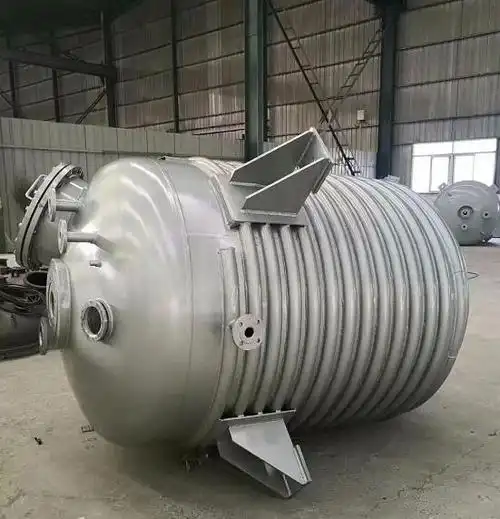
In the fields of chemical industry, pharmaceutical manufacturing, food processing, and new material synthesis, the reaction kettle (also known as reaction vessel or autoclave) is recognized as the "core heart" of production equipment. It undertakes the key task of completing various chemical and physical reactions under controlled conditions, and its performance and operational stability directly determine the quality, yield, and production safety of products. From small-scale laboratory R&D to large-scale industrial mass production, reaction kettles have evolved into a diverse family of equipment with standardized designs, customized configurations, and intelligent controls after years of technological iteration. To fully understand this critical equipment, it is essential to start with its basic principles, core structures, and working mechanisms, laying a solid foundation for its rational application, maintenance, and technical upgrading.
First of all, we need to clarify the basic definition and core functions of a reaction kettle. In essence, a reaction kettle is a closed container (or semi-closed container) designed to carry out chemical reactions or physical processes, which can precisely control key reaction parameters such as temperature, pressure, mixing speed, and reaction time to ensure that the reactants undergo targeted transformations to form the desired products. Unlike ordinary mixing tanks or storage tanks, the core advantage of a reaction kettle lies in its "controllability" and "adaptability" — it can not only provide a stable reaction environment for different types of reactions (such as exothermic, endothermic, catalytic, polymerization, and hydrolysis reactions) but also adapt to the characteristics of various reactants (such as corrosive, flammable, explosive, viscous, or solid-containing materials) through structural optimization and material selection. Its core functions cover four aspects: mixing and dispersion of reactants, heat transfer (heating or cooling) to control reaction temperature, pressure regulation to maintain reaction conditions, and sealed protection to prevent material leakage and ensure safety.
The working principle of a reaction kettle is based on the basic laws of chemical thermodynamics and mass transfer, and its entire operation process is a systematic coordination of multiple components. The general working process can be summarized as four stages: feeding, reaction, product discharge, and equipment cleaning. In the feeding stage, raw materials are added into the kettle body in a specific proportion through the feeding port. According to the reaction requirements, the feeding method can be manual feeding, automatic metering feeding, or continuous feeding. For reactions involving flammable, explosive, or toxic materials, an inert gas (such as nitrogen) purge system is usually used to replace the air in the kettle first to eliminate potential safety hazards. After feeding, the kettle body is sealed to ensure that the reaction proceeds in a closed environment, preventing the leakage of reactants, products, or by-products, and also avoiding the interference of external substances on the reaction.
The reaction stage is the core link of the reaction kettle's operation, which mainly relies on the coordinated work of the stirring system, heating/cooling system, and control system to realize the precise control of the reaction process. The stirring system is responsible for uniformly mixing the reactants in the kettle to eliminate concentration gradients and temperature gradients, thereby accelerating the reaction rate and improving the reaction uniformity. The stirring device is composed of a stirring shaft, stirrer, and transmission device — the motor drives the stirring shaft to rotate through a reducer, and the stirrer (with various types such as paddle type, anchor type, turbine type, and spiral belt type) stirs the materials to achieve mixing effects. The type of stirrer is selected according to the viscosity of the materials and the reaction characteristics: for low-viscosity liquid materials, paddle stirrers are usually used; for high-viscosity materials or materials containing solid particles, anchor type or spiral belt type stirrers are more suitable.
The heating/cooling system is used to adjust the temperature inside the kettle to the optimal range required for the reaction, which is crucial for the progress of the reaction. Chemical reactions are usually sensitive to temperature: too high a temperature may lead to side reactions, decomposition of products, or even safety accidents; too low a temperature will reduce the reaction rate, prolong the production cycle, and affect the yield. Common heating methods include steam heating, electric heating, heat transfer oil heating, and jacket heating. Steam heating is suitable for large-scale production with low energy consumption; electric heating is convenient and flexible, suitable for small and medium-sized reaction kettles or occasions where steam is inconvenient to use; heat transfer oil heating can achieve high-temperature heating (up to 300°C) and stable temperature control. The cooling system usually adopts jacket cooling or coil cooling, using cooling water or cooling oil to take away the heat generated by exothermic reactions to maintain the stability of the reaction temperature. For example, in the production of synthetic resins, a large amount of heat is released during the polymerization reaction, which needs to be quickly taken away by the cooling system to avoid the material from caking or decomposing.
The control system is the "brain" of the reaction kettle, which realizes real-time monitoring and automatic adjustment of reaction parameters. Modern reaction kettles are usually equipped with a PLC or DCS automatic control system, which is connected to sensors (temperature sensors, pressure sensors, pH sensors, liquid level sensors, etc.) installed in the kettle to collect real-time data such as temperature, pressure, reactant concentration, and liquid level inside the kettle. The control system compares the collected data with the preset reaction parameters, and automatically adjusts the heating/cooling power, stirring speed, feeding speed, and pressure relief volume to ensure that the reaction proceeds stably within the preset range. For example, when the temperature inside the kettle exceeds the set value, the control system will automatically increase the flow rate of cooling water or reduce the heating power; when the pressure is too high, the safety valve will automatically open to release pressure, preventing overpressure and explosion accidents.
After the reaction is completed, the product is discharged through the discharge port, and the type of discharge method is also selected according to the physical state of the product (liquid, solid, or paste). For liquid products, gravity discharge or pressure discharge can be used; for solid or paste products, a discharge device such as a screw conveyor may be required. After discharge, the inside of the kettle needs to be cleaned to avoid cross-contamination between materials in the next reaction. For reaction kettles used in the pharmaceutical and food industries, a CIP (Clean-in-Place) automatic cleaning system is usually equipped to ensure the cleanliness of the equipment and meet the relevant hygiene standards.
The core structure of a reaction kettle is closely related to its working principle, and each component plays an irreplaceable role. The main components include the kettle body, stirring system, heating/cooling system, sealing system, control system, and process nozzles. The kettle body is the main container for the reaction, usually made of corrosion-resistant, high-temperature resistant, and pressure-resistant materials (such as stainless steel, carbon steel, enamel, titanium alloy, etc.). The material selection is mainly determined by the characteristics of the reactants and products: for example, enamel reaction kettles are suitable for reactions involving strong acids and alkalis due to their excellent corrosion resistance; stainless steel reaction kettles (304, 316L) are widely used in the pharmaceutical and food industries due to their easy cleaning and non-toxicity; titanium alloy reaction kettles are used in harsh environments such as strong corrosion and high temperature due to their excellent mechanical properties and corrosion resistance.
The sealing system is a key component to ensure the closed operation of the reaction kettle, which is used to prevent the leakage of materials between the stirring shaft and the kettle cover. Common sealing methods include packing seal and mechanical seal. Packing seal has a simple structure, low cost, and easy maintenance, but its sealing performance is relatively poor, and it is suitable for low-pressure, low-temperature, and non-toxic material reactions. Mechanical seal has good sealing performance, low leakage, long service life, and is suitable for high-pressure, high-temperature, flammable, explosive, and toxic material reactions, but its structure is complex and the cost is relatively high. In addition, for high-pressure and high-purity reaction scenarios (such as semiconductor grade reagent synthesis), magnetic drive sealing is usually adopted to completely eliminate the leakage risk of dynamic sealing.
Process nozzles are set according to the needs of the reaction process, including feeding port, discharge port, sampling port, sight glass port, temperature measuring port, pressure measuring port, and inert gas inlet. These nozzles are reasonably arranged to facilitate feeding, sampling, monitoring, and maintenance, and also ensure the rationality of the internal flow field of the kettle body to avoid dead corners of mixing. For example, the sight glass port allows operators to directly observe the reaction status inside the kettle; the sampling port can take samples at any time to detect the reaction progress and product quality; the inert gas inlet is used to introduce protective gas to isolate air.
It should be emphasized that the working mechanism of the reaction kettle is not a simple superposition of individual components, but a systematic integration of multiple technologies. For example, the matching between the stirring system and the heating/cooling system directly affects the heat transfer efficiency and mixing uniformity: if the stirring speed is too low, the heat generated by the reaction cannot be quickly transferred to the cooling system, leading to local overheating; if the stirring speed is too high, it will increase energy consumption and may cause the material to splash or the stirrer to wear. The coordination between the control system and each executive component (such as heating device, cooling device, stirring motor) realizes the automation and intelligence of the reaction process, reduces manual operation errors, improves production efficiency, and ensures production safety.
In summary, the reaction kettle completes the transformation of reactants into products through the coordinated work of feeding, stirring, temperature control, pressure control, reaction, discharge, and cleaning. Its basic principle is to rely on precise control of reaction parameters to meet the requirements of chemical reactions, and its core structure is designed around the needs of reaction control and safety protection. With the continuous development of industrial technology, the working mechanism of reaction kettles is also constantly upgrading, moving towards more intelligent, efficient, energy-saving, and environmentally friendly directions. Understanding the basic principles and core structures of reaction kettles is not only the basis for correctly operating and maintaining equipment but also the key to realizing the optimization of production processes and the improvement of product quality.